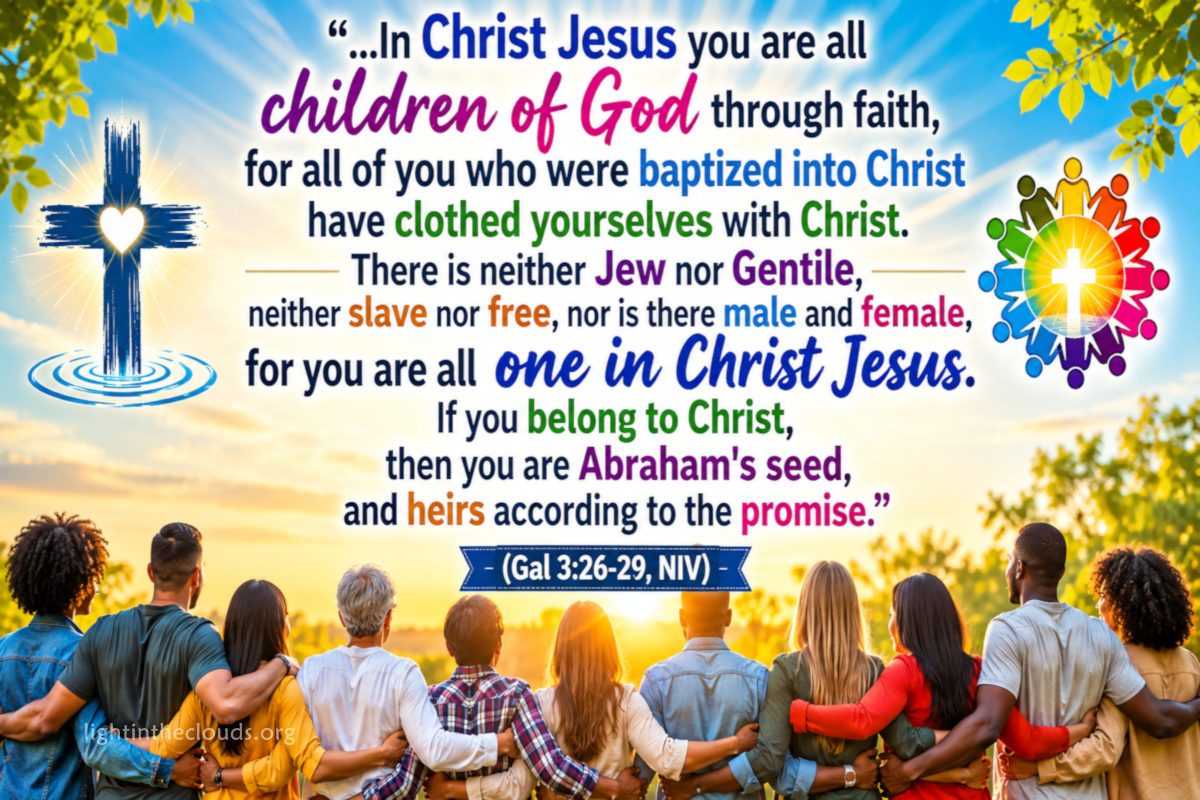
“…In Christ Jesus you are all children of God through faith, for all of you who were baptized into Christ have clothed yourselves with Christ. There is neither Jew nor Gentile, neither slave nor free, nor is there male and female, for you are all one in Christ Jesus. If you belong to Christ, then you are Abraham’s seed, and heirs according to the promise.” (Gal 3:26-29, NIV)
Gal 3:26-27
This passage is not primarily a statement about equality or social inclusion, as some people would lead us to believe. It’s not that those things are not important issues. But this text has a much bigger picture to it. The center of Paul’s statement here is identity. Because the gospel is not merely about forgiveness; it is about participating in the very life of Christ. The passage for this message answers one of the most fundamental questions in Scripture:
Who are the people of God?
And Paul’s answer is astonishing. He declared that the people of God are all those who are “in Christ.”
Clothed with Christ
…In Christ Jesus you are all children of God through faith… for all of you who were baptized into Christ have clothed yourselves with Christ…”* (Galatians 3:26-27)
There are moments in life when clothing completely changes how others see us. A judge puts on a robe. A firefighter puts on protective gear. A soldier wears a uniform. I take off my drywall clothes and put on a suit to come to church. Clothing tends to identify people with a particular calling. If I went to a store shopping with my drywall clothes on, I would often get people asking me to come to their place to do some work because they could see that I was a drywaller.
Paul says something infinitely greater has happened to the believer. Believers in Christ Jesus dress in something absolutely “out of this world.” True Christians wear the very best clothing in the world. And people tend to notice!
The Bible says in our opening text that we have been clothed with Christ Himself. This is a much bigger picture than just having our sins covered. Or being forgiven! It is much more than receiving a legal declaration of righteousness. When we are in Christ, when we are clothed in His righteousness, Christ Himself becomes the defining reality of our existence.
The Father no longer simply sees forgiven sinners. He sees His Son. He sees Christ in you the hope in glory! Isaiah said it like this:
“He has clothed me with the garments of salvation and arrayed me in a robe of righteousness…” (Isa. 61:10)
But Paul goes even further. The robe is not merely righteousness. The robe is Christ Himself. And one really interesting thing here is how we are clothed in Christ, because we are now entering His Story. Paul immediately connects this special clothing with baptism. Now, baptism is not magic. The water has no saving power. But baptism publicly declares something that faith has already accomplished.
The old identity has died. A new identity has begun.
Just as Israel passed through the Red Sea into a completely new existence, the Christian passes through baptism into participation in Christ’s life, death, and resurrection. It is not simply that Christ died for us. Because NOW, we live in Him. “In Him we live and move and have our being.” (Acts 17:28). “In Christ we live and move and have our being!”
That little expression, “in Christ,” may be the most amazing phrase Paul ever wrote. Notice the order. Paul does not say: Obey well enough…Become holy enough…Understand enough doctrine… and eventually God will adopt you.
He says, “You are all children of God through faith.” (Gal 3:26) Sure, obedience matters. Sanctification matters. Character matters. Doctrine matters. But none of these create sonship. They grow out of sonship. When we are adopted as the sons and daughters of God, we want to obey, not to belong. But because we belong.
The New Person.
Here is where Paul reaches one of the most revolutionary statements in Scripture. “There is neither Jew nor Greek, slave nor free, male nor female…” (Gal 3:28). Paul is not pretending that these distinctions disappear. Jews remain Jews. Greeks remain Greeks. Men remain men. Women remain women. The differences still existed. But none of them determined any person’s standing before God.
Before Christ, identity flowed from ethnicity, social status, gender, family, tribe, or achievements of some kind. After Christ, identity flows from only one source. Union with Christ. This is not sameness. It is unity. Just as the Father and Son, and The Holy Spirit are distinct Persons yet perfectly one in purpose and love, believers remain wonderfully different while sharing one life in Christ.
This is because Jesus did not come merely to prepare us to meet God. He came to prepare us to live with God. The unity in the Church, or amongst God’s children, as described here is not organizational unity. It is participation in the very fellowship that has always existed between the Father, Son, and Holy Spirit.
It started with Abraham’s Seed. Paul states what may have seemed impossible to his Jewish readers. “If you belong to Christ, then you are Abraham’s seed.” Notice Paul does not say “If you are physically descended from Abraham…” Nor does he say, “If you become ethnically Jewish…” The determining factor is Christ. If you are in Christ, you ARE Abraham’s seed.
Earlier in the chapter Paul said that the singular “Seed” promised to Abraham ultimately referred to Christ (Gal. 3:16). Now he reaches his conclusion. If Christ is the Seed…and we are in Christ…then we share His inheritance. Not because we deserve it. Not because we replaced Israel. But because we participate in the life of Israel’s Messiah. The inheritance is not earned. It is shared. Everything belongs first to Christ. Then, astonishingly, everything that belongs to Christ is shared with those united to Him. See Isaiah 53 and Galatians 3.
Isaiah 53 helps explain what Isaiah anticipated. Isaiah says, “By His stripes we are healed.” Paul explains what that healing ultimately accomplishes. The cross does more than forgive guilt. It restores relationship. It heals alienation. It creates a new person. New people. The cross brings estranged sinners into the family life of God. Healing is not merely physical restoration, though Scripture promises that one day. It is the healing of humanity itself through union with the suffering Servant. Whole person healing and wellness.
The Three Angels’ Message
This also connects well with Revelation 14. The first angel announces the “everlasting gospel.” The everlasting gospel is not simply the announcement that sins can be forgiven.
It is the announcement that, through Christ, fallen human beings are restored to their identity as worshipers who reflect the Creator. The beast creates identity through coercion. Babylon creates identity through confusion and compulsion. Christ creates identity through union with Himself. This is why I have sometimes replied when asked “Who are you?” “I am the one that Jesus loves.”
The everlasting gospel calls every nation, tribe, language, and people into one family. Sons and daughters of God. And not by erasing their uniqueness, but by clothing them all with Christ.
The most remarkable phrase in our opening passage (Gal 3:26-29) is not “children of God.” Not “heirs.” Not even “Abraham’s seed.” It is simply: “In Christ Jesus.” Everything else flows from those three words. “In Christ Jesus.” Outside Christ there are endless divisions and separateness. “In Christ” there is one new human family called “Christian,” from ‘every nation, tongue, tribe and people. As God’s children, His adopted children, we are called “Christian” because we are like Jesus when we are “in Christ.”
Outside Christ we define ourselves by our past, our failures, our successes, our culture, our politics, our race, or our achievements. In Christ there is one defining reality. Christ is our life.
The Christian life is not just trying harder to become someone else. It is learning, day by day, to live out the identity God has already given us in His Son. That is why Paul can later say, “It is no longer I who live, but Christ lives in me” (Gal. 2:20).
The “robe” that we put on at conversion is not something we wear over our old life as some sort of covering. To mask what we are. It is the beginning of an entirely new existence. (2 Cor 5:17) Every day, through faith, we grow into the reality of the One with whom we have already been clothed. (Gal 3:27)
We could note here how that Genesis 32:24-28 reflects the nature of some of the conflict we face as “seed of Abraham.” This passage is such a good example of what we are talking about here.
Now, I wouldn’t say Genesis 32: 24-28 is directly about all believers being as Abraham’s seed, but I do think Jacob’s experience functions as a pattern for what it means to inherit the promises through faith.
Jacob was about to enter the Promised Land. Genesis 32 occurs at a critical moment. Jacob has received God’s promises for twenty years. God has protected him, prospered him, and repeatedly assured him of the covenant. Yet before he enters the land, one obstacle remains. Jacob himself. The greatest danger is no longer Laban behind him. (Gen 31:22-23). His greatest danger was the Jacob within him.
Isn’t that also true of us? We tend to think our greatest enemies are external. Persecution. Temptation. Difficult people. Or even Satan himself. Scripture repeatedly suggests that God’s deepest work is often in dealing with the heart of His own people. There is even a promise about God giving us a new heart. (Ezekiel 36:26). The struggle in the great controversy has always been about identity. Jacob had spent his entire life living up to his name.
“Jacob” means “heel-grabber” or “supplanter.” His whole life had been characterized by seizing. He seized Esau’s heel. He seized the birthright. He seized the blessing. He seized Rachel. Even when God had already promised him the inheritance, Jacob still tried to secure it through his own ingenuity. His own strength and efforts. And that is exactly the opposite of faith.
Faith receives. Jacob grasped. So, when the mysterious Man asks, “What is your name?” it is not because He lacks information. It is an invitation to confession. Jacob must finally admit, “I am Jacob.” “I am the grasping one.” “I am the deceiver.” (Gen 32:27) Only then comes the new name. “Your name shall no longer be Jacob, but Israel.” (Gen 32:28)
The way this all happens is very interesting. First, confession. Then transformation. This is very much like Galatians 3. We are not first made heirs because we have become different people. Rather, God gives us a new identity in Christ and then calls us to live out that identity. (see Rom 12:1-2). Praise His Holy name!
Today’s message is saying that the blessing came through surrender. The most amazing paradox of Genesis 2 is that Jacob “prevails” only after he loses. The touch on his hip changes everything. (Gen 32:25) From that moment on, Jacob cannot wrestle in his own strength. He can only cling. Victory is sure when self is surrendered.
Before sunrise Jacob had been wrestling against God. After sunrise he is holding onto God. Jacob is clinging to God. There is an enormous difference.
Perhaps that is what Hosea means when reflecting on this event. “He strove with the Angel and prevailed; he wept and sought His favor” (Hosea 12:4).
Jacob’s victory was not in overpowering God. Jacob’s victory was refusing to let go of God! Isn’t that what makes the Christian life? Paul says, “You have clothed yourselves with Christ.” (Gal 3:27) But what does that look like in experience? What should we see if someone is “clothed in Christ?” Perhaps Genesis 32 gives us the best answer.
The Christian life is a continual surrender of the old “Jacob.” Every day the old self wants to secure God’s promises through self-reliance, self-protection, self-promotion, and self-sufficiency. The Spirit continually brings us to the Jabbok. Not to destroy us. But to change our name.
Notice that Jacob receives a new name before he meets Esau. Nothing outward has changed. Esau is still approaching with four hundred men. The circumstances remain the same. The only thing that has changed…is Jacob.
That is often God’s order. We pray, “Lord, change my circumstances.” God says, “First, let Me change you.” Only then do we discover that the greatest miracle wasn’t what happened around us. It was what happened within us. The things that happen to us or around us are not the miracle. We are the miracle.
When Jacob leaves Jabbok limping, we see a connection to the life of Christ. Jesus leaves Gethsemane wounded. Jacob bears the mark of his encounter. Jesus bears the wounds of ours. But here’s the difference. Jacob limped because of his own weakness. Christ was wounded because of our weakness. And now Paul can say, “You have clothed yourselves with Christ.” (Gal 3:27)
In a profound sense, as Christians, we inherit not Jacob’s limp, but Christ’s life. Yet Jacob’s limp becomes a fitting symbol of the believer’s walk. We no longer stride confidently in our own strength. We walk in dependence upon Another. “His strength being made perfect in our weakness.”
Could this be why Paul emphasizes, “If you belong to Christ, then you are Abraham’s seed.” Abraham learned to trust God’s promise. Jacob learned that trust often requires God to break through our self-sufficiency. The inheritance does not pass to those who are naturally strong, clever, or capable. It passes to those who, like Jacob at dawn, have come to the end of themselves and can only say, “I will not let You go unless You bless me.”
That cry is not the voice of human determination. It is the voice of faith. And in the Bible, faith is precisely the defining characteristic of Abraham’s true children. It is no accident that the patriarch who spent his life grasping whatever he thought he wanted or needed, ends his greatest struggle simply clinging to God. That movement, from grasping to clinging, captures the transition from the old life in Adam to the new life “in Christ.”
2 Corinthians 5:17 is one of the clearest explanations of what Paul means by “in Christ.” It is often quoted as though it simply means, “Now that you’re a Christian, you should live differently.” While that’s true, Paul’s point is much deeper. He is describing a new creation.
“Therefore, if anyone is in Christ, they are a new creation; the old has passed away; behold, the new has come.” Notice that Paul does not say: “If anyone believes in Christ…” or “If anyone follows Christ…” Those are certainly Biblically sound ideas. But here his emphasis is on agency, or perhaps we can say “sphere of existence.”
A person is now in Christ. That little phrase changes everything. A new realm of existence. Think about how Paul uses similar language elsewhere. Before conversion we are “In Adam” (Rom. 5), “in the flesh” (Rom. 8), “in darkness” (Eph. 5).
After conversion we are “In Christ”, “in the Spirit”, “in the light”, etc. Paul is not merely describing a change of opinion. He is describing a transfer from one realm into another. This reminds me of Israel crossing the Red Sea. The same people stood on the opposite shore. The same names. The same faces. The same memories. But they no longer belonged to Egypt. They belonged to God.
Likewise, the believer may look much the same outwardly, but spiritually he or she now belongs to an entirely different order of existence. The phrase “new creation” immediately echoes Genesis. Genesis says “In the beginning God created…” Now Paul says God has begun creating again. This isn’t merely self-improvement. Nor is it merely moral reform. It is the beginning of God’s final purpose for humanity. The same God who once said, “Let there be light,” now shines into human hearts (2 Cor. 4:6).
Paul intentionally links creation and redemption. Salvation is not simply escaping judgment. It is God’s recreation of humanity. This fits so well with Galatians 3.
Notice how naturally the ideas connect. Galatians says, “You are children of God.” You have clothed yourselves with Christ. You are Abraham’s seed. 2 Corinthians explains how that can possibly be true. It is because God has made you part of a new creation. Your deepest identity is no longer determined by your ancestry. Nor by your failures. Nor by your accomplishments. Nor even by your past.
It is determined by Christ.
This is why Paul can say in Galatians “There is neither Jew nor Greek…” He is not denying history. He is saying a greater reality now defines us. Christ as the beginning of the new creation This becomes even bigger when we remember Christ’s resurrection.
Paul calls Christ “the first fruits.” Elsewhere He is called “the firstborn from the dead.” Jesus is not merely the first person to rise. He is the first member of the new humanity. His resurrection is the dawn of the new creation. So, when Paul says we are in Christ, he means we already participate in that new creation life. Not fully. Not yet. But truly. We still await the resurrection of our bodies. Yet eternal life has already begun. (John 3:36)
Now, Jacob received a new name. But he still looked like Jacob. He still remembered his failures. He still walked with a limp. Nevertheless, God declared, “You shall no longer be called Jacob, but Israel.” (Gen 32:28) His identity changed before his experience fully reflected it. God saw the potential and where it was going to go. That is remarkably similar to Paul’s thought.
The believer is declared to be part of God’s new creation. Yet we still struggle. We still limp. We are still learning to live according to our new identity. Sanctification is, in one sense, learning to live as the new creation we already are. The life in Christ that we are called to.
Isaiah 53 tells us that “By His stripes we are healed.” Perhaps we can now say what that healing ultimately accomplishes. Christ’s suffering does not merely repair damaged lives. It inaugurates a new creation. The healing Isaiah foresaw is not only the removal of guilt. It is the restoration of humanity itself. The broken image of God begins to be restored. That restoration reaches its climax in the resurrection, but it begins now in everyone who is “in Christ.”
Notice that Paul almost never tells Christians to create a new identity. To begin some modern-day behavior modification program. He tells them to live from the one God has already given them. That’s a profound difference. Churchianity often says, “Become someone worthy, and perhaps God will accept you.” The gospel says “God has united you to His Son. Now learn to live out the reality of who you already are called to be.” That is the heartbeat of the phrase “in Christ.”
It is not simply a description of our relationship with Jesus. It is God’s declaration that the life of the risen Christ has become the defining reality of our existence. Jesus did not come merely to make forgiveness possible. He came to restore humanity to the kind of life that has always existed between the Father, Son, and Holy Spirit. To be “in Christ” is to participate even now in that life. We are not spectators of the new creation; but by God’s grace, we are part of it.
1 Peter 1:5 fits into this picture extraordinarily well because it answers a question that naturally arises from everything Paul has said. If we are “in Christ,” if we are a new creation, if we are Abraham’s seed and heirs according to the promise, then one question remains. How do we make it home to Heaven?
We are literally “kept by the power of God.” Peter’s answer is “…those who are kept by the power of God through faith for salvation ready to be revealed in the last time.” (1 Peter 1:5)
“Kept by the power of God.”
Peter does not say we are kept by the strength of our faith. Nor by the consistency of our obedience. Nor by our theological understanding. He says we are kept by the power of God. This fits perfectly with Jacob. Jacob crossed the Jabbok limping. If the future of God’s covenant depended on Jacob’s strength, the covenant would have ended that morning.
Instead, Jacob was preserved by God’s faithfulness. His limp became a continual reminder that God’s promises rested on God’s power, not Jacob’s. That is exactly Peter’s point.
Peter says, “through faith.” But Peter doesn’t stop there. God’s power works through faith. Faith is not the power. Faith is how we receive God’s power. Imagine a branch attached to a vine. The life is not in the branch. The life is in the vine. The branch simply remains connected. That is very close to Paul’s idea of being “in Christ.”
Faith is the continual dependence that keeps us consciously abiding in the One who is our life. Galatians says You are children of God through faith. Peter says You are kept by God’s power through faith. Faith is not merely how we begin the Christian life. It is how we continue in it.
We never graduate beyond faith. The Christian life never becomes self-sustaining. 2 Corinthians 5:17 says, “If anyone is in Christ, he is a new creation.” Peter says That new creation is being guarded by God’s own power until the final salvation is revealed.
The new creation is already true. Yet its fullness is still future. The inheritance has already been given. Its complete enjoyment still awaits Christ’s return. Peter says this just one verse earlier: “…an inheritance incorruptible, undefiled, and unfading, reserved in heaven for you…” (1 Pet. 1:4) “…who are kept by the power of God…” The inheritance is guarded. The heirs are guarded. Nothing is left to chance.
Think again about Abraham’s seed. Israel inherited the land because of God’s promise. Yet every day they still had to trust Him. The Jordan did not part because Israel was strong. Jericho did not fall because Israel had better military strategy. The inheritance was entered by continual dependence upon God’s power. Peter is saying something similar about the Christian life.
We are heirs. But we are heirs who walk by faith from beginning to end. Isaiah 53 describes the Servant bearing our sins and healing us. Peter is one of the New Testament writers who explicitly connects believers to Isaiah 53 when he said, “By whose stripes you were healed.” (1 Pet. 2:24)
Peter isn’t merely talking about forgiveness. He’s describing an entirely new life “…that we, having died to sins, might live for righteousness.” That sounds very much like Paul’s “new creation.” The healing Isaiah promised is not only the removal of guilt, but the restoration of a life lived in close fellowship with God.
1 Peter 1:5 tells us why that restoration will reach its goal Because God Himself is preserving it. “Kept by the power of God.”
There is an even deeper connection. One theme keeps surfacing: God is not merely preparing people for heaven; He is preparing people to live with Him. 1 Peter 1:5 fits perfectly into that idea. God does not simply hand us salvation and say, “Now don’t lose it.” Rather, the God who calls us into union with Christ is the same God who continually guards, shapes, disciplines, sustains, and preserves us until that union reaches its full expression at the resurrection.
Galatians 3 tells us who we are. Children of God. Clothed with Christ. Abraham’s seed. 2 Corinthians 5 tells us what we are. A new creation. Genesis 32 shows how God transforms us. By bringing us from self-reliance to dependence. 1 Peter 1:5 tells us why we can have confidence: because the God who began this new creation is Himself keeping us by His power through faith until the inheritance is fully revealed.
That, I think, is why Peter can later speak about believers rejoicing even amid trials (1 Pet. 1:6–9). The trials are not evidence that God has stopped keeping His people. In many cases they are examples of how He teaches them to live as Jacob finally did. Not grasping for blessings in their own strength but clinging to the One whose power alone can bring them safely into the inheritance promised to Abraham.
“…to all who did receive [Christ], to those who believe in his name, he gives the right, He gives the power to become children of God. Children born not of natural descent, nor of human decision or a husband’s will, but born of God.” (John 1:12-13)
Who Are God’s People? They are “in Christ.” They are kept by the power of God. In Christ alone!