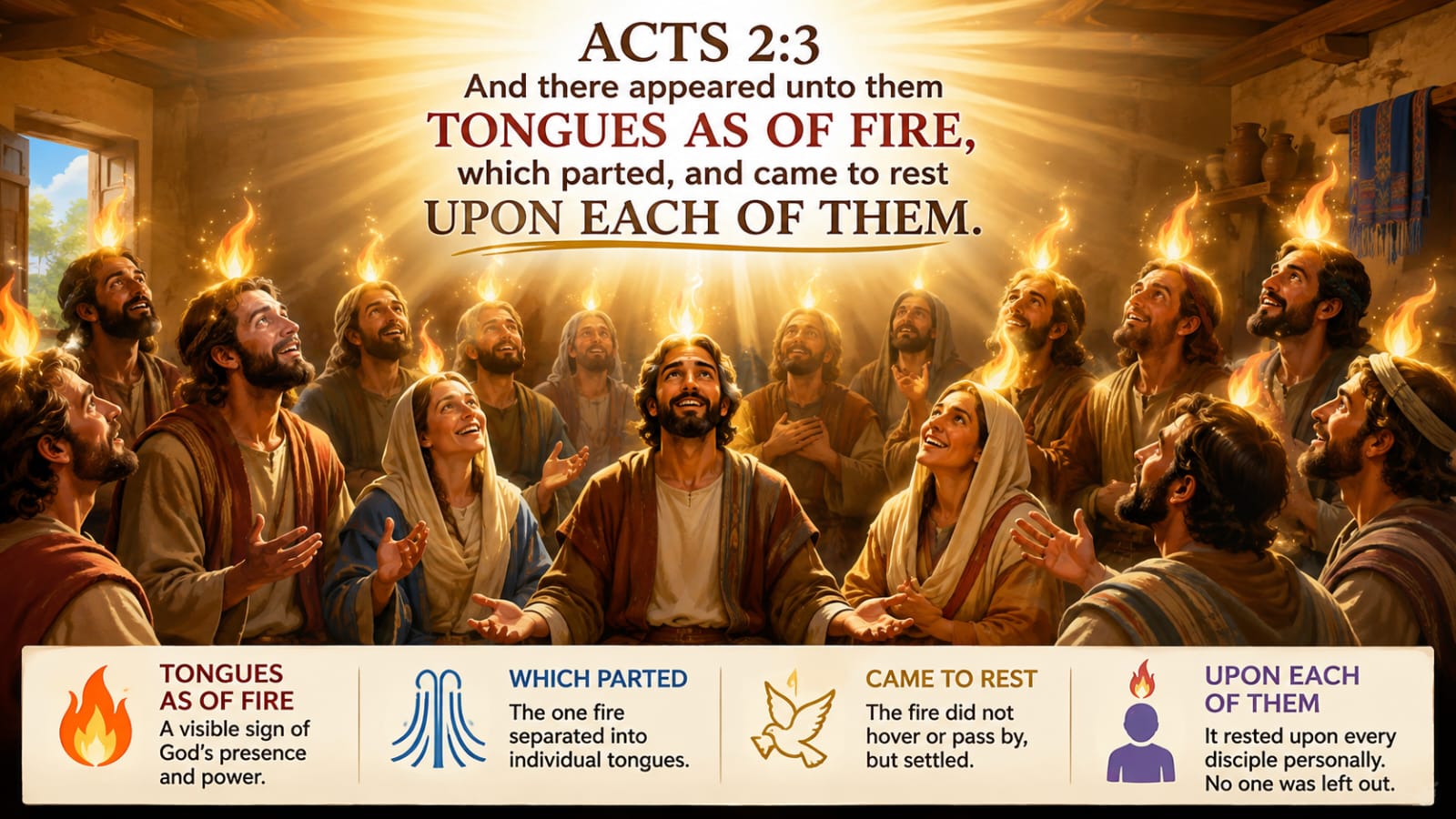
“And tongues as of fire appeared unto them, being distributed; and it sat upon each of them.” (Acts 2:3, MKJV)
fire Acts 2:3
Christ’s Promise Fulfilled
The time had now come. The Spirit had been waiting for the crucifixion, resurrection, and ascension of Christ. For ten days the disciples offered their petitions for the outpouring of the Spirit, and Christ in heaven added His intercession. This was the occasion of His ascension and inauguration, a jubilee in heaven. He had ascended on high, leading captivity captive, and He now claimed the gift of the Spirit, that He might pour it out upon His disciples. {6BC 1055.2}
In our opening text for this message, we must note several aspects that really stand out, and that have immense, practical significance for believers today. Throughout Scripture, fire is often associated with the presence of God, and the work of God.
Moses encountered God in the burning bush (Exodus 3:2).
God led Israel by a pillar of fire (Exodus 13:21).
God’s glory appeared as consuming fire on Sinai (Exodus 24:17).
Daniel’s three friends met Jesus in the flames of the fiery furnace (Dan 3:6, 21, 25)
The most amazing thing to notice here first is how at Pentecost, the fire did not appear on a mountain or in a sanctuary. Or in any kind of building or organization. The fiery tongues of The Holy Spirit rested, individually on people. This signified that God was now dwelling in His people, individually, through the Holy Spirit. For believers today, this points to the reality that God desires to live and work through individual Christians, wherever they can be found, and not merely through institutions or buildings.
“…as the people were in expectation, and all men mused in their hearts of John, whether he were the Christ, or not; John answered, saying unto them all, I indeed baptize you with water; but one mightier than I cometh, the latchet of whose shoes I am not worthy to unloose: he shall baptize you with the Holy Ghost and with fire: (Luke 3:16)
The fire was divided yet remained one. Luke says the tongues of fire were “distributed” among them. (Acts 2:3, MKJV). There was one heavenly gift. One Spirit, but it was shared among many believers. (Eph 2:18, Eph 4:4). This reflects Paul’s later teaching: “There are diversities of gifts, but the same Spirit.” (1 Corinthians 12:4)
No single believer received all the gifts or all the work. Each disciple received a portion, that they could each handle, with their own personal, specific gifts for service. For believers today, this teaches that every Christian has a role in God’s mission. The Spirit equips different people differently, but all are part of one body. And all are equipped. Let us consider carefully the fire that sat upon each one. Luke is very careful to say how “it sat upon each of them.” Not merely on Peter. Not only on the apostles. Not just on the leaders. Every disciple present that day in the upper room received this sign. This emphasizes the personal nature of the Spirit’s work. God’s power is not reserved for a spiritual elite. Every surrendered believer may receive the Spirit’s presence, power, and enabling.
Fire Purifies. In Scripture, fire often symbolizes purification. Gold is refined by fire (Malachi 3:2-3). Isaiah’s lips were touched with a burning coal before his prophetic ministry (Isaiah 6:6-7). Before the disciples could effectively witness to the world, God first had to transform them. Pride, jealousy, self-seeking, and unbelief had to give way to humility and love. For believers today, the Spirit does not merely empower; He also sanctifies. The same fire that gives power also purifies character.
Why does the fire appear as tongues? It is very significant that the fire appeared in the form of “tongues.” Immediately afterward, the disciples began speaking so that people from many nations could understand the gospel. The symbol of “fiery tongues” points to speech empowered by God. This connects with Jesus’ promise: “You shall receive power when the Holy Spirit has come upon you; and you shall be witnesses to Me.” (Acts 1:8). The Spirit was given not merely for personal experience but for witness. The gift of tongues is never a confusing babbling language that no one can understand. For believers today, this affirms that one evidence of the Spirit’s work is that He uses our words to testify about Christ.
That which was from the beginning, which we have heard, which we have seen with our eyes, which we have looked upon, and our hands have handled, concerning the Word of Life, (for the Life was revealed, and we have seen it and bear witness, and show to you the everlasting Life, who was with the Father and was revealed to us), that which we have seen and heard we declare unto you, so that you also may have fellowship with us. And truly our fellowship is with the Father and with His Son Jesus Christ. (1 John 1:1-3, MKJV)
As we study the conflict between good and evil, there is another context to be noticed here. At Babel (Genesis 11), human pride resulted in divided languages and scattered peoples. At Pentecost, (Acts 2) the Holy Spirit enabled many languages to communicate one united gospel message.
In a special sense, Pentecost begins God’s work of reversing Babel. Satan divides; the Spirit unites. Satan confuses truth; the Spirit illuminates truth. Satan scatters the flock; Christ gathers them into the fold. The fire resting upon each believer today shows that God advances His kingdom not primarily through force, or fine tuned intellect; but through a transformed people who are literally filled with God’s Holy Educating Spirit.
God’s people are NOT consumed but refined. They are transformed. Notice that the fire did not consume the disciples. In the Old Testament, God’s holiness often appeared as consuming fire. Yet at Pentecost the fire rested upon them without destroying them. The same thing happened with the three Hebrew worthies who were cast into the fiery furnace. (see Dan3). Why is this? Why weren’t they consumed by the fire?
Because through Christ’s sacrifice they could stand in God’s presence. The same holy fire that would consume sin could now dwell with redeemed sinners. God is no longer merely with His people as in the wilderness; through the Spirit He is now within His people, empowering them to carry the light of Christ into a dark world. That’s why isaiah said “Arise! Shine! For thy Light IS come and the glory of The Lord has risen upon you.” (isa 60:1). God’s Holy Spirit was to live in each person. “And I will put my spirit within you, and cause you to walk in my statutes, and ye shall keep my judgments, and do them. (Ezekiel 36:27)
While Luke does not explicitly say that the disciples “lost” anything when the tongues of fire rested upon them,Dan 3 explicitly states that the ropes binding Shadrach, Meshach, and Abednego were burned away. But that is the only thing they lost. In Daniel 3, the fire burned only the bonds: “I see four men loose, walking in the midst of the fire…” (Daniel 3:25). The fire did not destroy the men; it destroyed what held them captive. The fire only destroyed what was between them and Jesus. Today, when we surrender our lives to Jesus the only thing we “lose” is whatever was a barrier between us and Jesus.
In Acts 2, the fire appears to have burned away several kinds of bonds that had previously hindered the disciples. Like fear. Before Pentecost, the disciples often acted out of fear. After Christ’s arrest, they fled (Mark 14:50). Peter denied Jesus (Luke 22:54-62). After the resurrection, they gathered behind closed doors “for fear of the Jews” (John 20:19).
After Pentecost, things had become quite different. These same men publicly and fearlessly proclaimed Christ before crowds and authorities. Self-seeking ambitions that bound them in sin were gone! Before the cross, the disciples repeatedly argued about who would be greatest. Even when they were walking right beside Jesus! Luke 22:24 records a dispute among them over rank. James and John sought positions of honor (Mark 10:35-37).
After Pentecost, the emphasis shifts from personal status to service and mission for others. The fire seems to have consumed much of their pride and ambition. There was so much misunderstanding of Christ’s kingdom. Even after the resurrection they asked: “Lord, will You at this time restore again the kingdom to Israel?” (Acts 1:6). Their expectations still contained elements of an earthly kingdom. After receiving the Spirit, their focus became Christ’s heavenly kingdom and the salvation of souls. As Jesus Himself said it: “the kingdom of God is within you.” (Luke 17:21)
There are sometimes many barriers between believers. The disciples had different personalities, backgrounds, and perspectives. Yet before Pentecost they spent time in united prayer:
“These all CONTINUED with one accord…” (Acts 1:14).
The Holy Spirit came upon an already united church. Many commentators have noted that Pentecost did not create unity out of nothing; rather, it would seem that the disciples had first surrendered all of the attitudes that divided them, and then the Spirit sealed that unity with great power and promise.
Now, in Daniel 3, Babylon sought to bind God’s people through coercion. The fire revealed that God’s presence was stronger than Babylon’s chains. In Acts 2, the enemy’s chains were less visible but no less real. Heavy chains of fear, pride, unbelief, selfishness, and misunderstanding. The fire of the Spirit did not destroy the disciples; it destroyed obstacles, it broke the chains that prevented them from fully serving Christ. In Daniel 3, the fire burned away very noticeable physical bonds. In Acts 2, the fire burned the less noticeable, yet very present personality traits that were also bonds, lessening their impact for ministry.
Both stories reveal a similar principle. When God brings His people through His fire, He does not intend to destroy them. He intends to remove whatever keeps them from walking freely with Him. Jesus even said “Keep company with me and you’ll learn to live freely and lightly.” (Mat 11:30, MSG)
The book of Malachi also has some possible connection here:
“And He shall sit as a refiner and purifier of silver.” (Mal 3:3)
A refiner’s fire does not exist primarily to destroy the metal; it removes impurities so the image of the refiner can be seen in it. In the process of refining metals, the raw metal is heated with fire until it melts. The impurities separate from it and rise to the surface. They are skimmed off, leaving the pure metal. Without this heating and melting, there could be no purifying. As the impurities are skimmed off the top, the reflection of the worker appears in the clear, pure surface. As we are purified by God, his reflection in our life will become more and more clear to those around us. Pentecost appears to be exactly that kind of fire. The disciples emerged from it still themselves, yet transformed into freer, bolder, purer, and more fully reflecting of Christ than ever before. The two scenes each reveal different aspects of Christ’s character and mission. Together they form a very powerful and complete picture of the everlasting gospel (Rev 14:6-12) changing hearts and lives.
In Daniel 3 they reflected Christ through faithfulness under trial. Before entering the fiery furnace, the three Hebrews declared:
“Our God whom we serve is able to deliver us… But if not, be it known unto thee, O king, that we will not serve thy gods…” (Daniel 3:17-18). This reflects Christ in several ways. Unwavering loyalty to God is the first thing we notice. Jesus remained faithful to His Father regardless of the cost. We see that very strongly when Jesus said “Not my will, but thine, be done.” (Luke 22:42) The three Hebrews, like Jesus, also chose obedience even if it meant death. They did not decide to be faithful because they knew they would be delivered; they were faithful because God was worthy of obedience, and they did not concern themselves with those consequences.
In The Great Controversy, Christ never once yielded to Satan’s temptations (Matthew 4:1-11). Likewise, the Hebrews would not bow, even when everyone else did. In a world of compromise, they stood firm. Their trial in the fiery furnace became a testimony to Babylon. Just as Christ revealed the Father before a watching universe, these young men revealed the reality of the true God before a pagan empire.
Fellowship with Christ in His suffering is what the fiery furnace was about. The desire of the disciple of Christ is that “That I may know him, and the power of his resurrection, and the fellowship of his sufferings, being made conformable unto his death;” (Phil 3:10) In Daniel 3, the most remarkable part is that Christ Himself appeared in the furnace. “The form of the fourth is like the Son of God.” (Daniel 3:25). “How did Nebuchadnezzar know that the form of the fourth was like the Son of God? He had heard of the Son of God from the Hebrew captives that were in his kingdom. They had brought the knowledge of the living God who ruleth all things.” {4BC 1169.7}
Daniel’s friends reflected Christ most clearly not by escaping the fire but by walking with Jesus in the flames of their persecutions or trials. For believers today, this suggests that Christ is often seen most clearly in us when we remain faithful during our own suffering.
God’s People Reflect Christ Through Spirit-Empowered Mission
At Pentecost, (Acts 2) the emphasis shifts from endurance to witness. Proclaiming Christ. The disciples immediately began speaking about God’s mighty works. Peter’s sermon was centered on Jesus. His life. His death. His resurrection. His exaltation in glory. Just as Christ came to reveal the Father, the disciples now revealed Christ.
Before Pentecost, the disciples often focused on themselves. After Pentecost, their main concern became the salvation of others. This reflects Christ, who “came not to be ministered unto, but to minister.” (Mark 10:45). God’s true people are followers who become more like Jesus in their sufferings. Jesus prayed for this kind of unity. Jesus prayed: “That they all may be one.” (John 17:21). At Pentecost, that prayer became a highly visible reality. Their unity reflected the unity between the Father and the Son.
Jesus Christ described Himself as: “the light of the world.” (John 8:12). At Pentecost, that light began shining through His followers. The fire resting on them symbolized that they were now being called to carry His light to the nations. “Every nation, kindred, tribe, tongue, and people.” The difference between the two stories is very telling:
Daniel 3
Acts 2
Christ beside them
Christ within them through the Spirit
Faithfulness under persecution
Witness to the world
Refusing to bow
Proclaiming Christ
Fire tests character
Fire empowers mission
Standing before a king
Speaking to entire nations
In both stories, they reflected Christ more fully because self interest was no longer controlling them. The Hebrews valued God’s honor even above their own lives. The disciples valued God’s mission above their own fears. In Daniel 3, Christ was reflected through faithfulness. In Acts 2, Christ was reflected through fruitfulness. And in both cases, the fire revealed what was already true in the heart: a people fully surrendered to God who became living witnesses to the character of Christ before a watching world.
Pentecost will be repeated with far greater power. “It is with an earnest longing that [we can] look forward to the time when the events of the day of Pentecost shall be repeated with even greater power than on that original occasion in Acts, chapter two. John says, “I saw another angel come down from heaven, having great power; and the earth was lightened with his glory.” (Rev 18:1). Then, as at the Pentecostal season, the people will hear the truth spoken to them, every man in his own tongue. {6BC 1055.5}
God can breathe new life into every soul that sincerely desires to serve Him, and can touch the lips with a live coal from off the altar, and cause them to become eloquent with His praise. Thousands of voices will be imbued with the power to speak forth the wonderful truths of God’s Word. The stammering tongue will be unloosed, and the timid will be made strong to bear courageous testimony to the truth. May the Lord help His people to cleanse the soul temple from every defilement, and to maintain such a close connection with Him that they may be partakers of the latter rain when it shall be poured out. The reason this is not happening now is that so many only want to assemble “of their own accord,” not with “one accord.”
Heaven’s Reservoir of Power not Locked
And in the fulfilling of the day of Pentecost, they were all with one accord in one place. And suddenly a sound came out of the heaven as borne along by the rushing of a mighty wind, and it filled all the house where they were sitting. And tongues as of fire appeared to them, being distributed; and it sat upon each of them. And they were all filled of the Holy Spirit, and began to speak in other languages, as the Spirit gave them utterance. (Acts 2:1-4)
“God is willing to give us a similar blessing, when we seek for it as earnestly.” {6BC 1055.3}
“The Lord did not lock the reservoir of heaven after pouring His Spirit upon the early disciples. We also may receive of the fullness of His blessing. Heaven is full of the treasures of His grace, and those who come to God in faith may claim all that He has promised. If we do not have His power, it is because of our spiritual lethargy, our indifference, our indolence. Let us come out of this formality and deadness.” {6BC 1055.4}
Pentecost To Be Repeated With Greater Power
“Then we shall know, if we follow on to know Jehovah. His going out is prepared as the morning; and He shall come to us as the rain, as the latter and former rain to the earth.” (Hosea 6:3)
Be glad then, sons of Zion, and rejoice in Jehovah your God. For He has given you the former rain according to righteousness, and He will cause the rain to come down for you, the former rain and the latter rain in the first month. (Joel 2:23)
And it shall be afterward, I will pour out My Spirit on all flesh. And your sons and your daughters shall prophesy; your old men shall dream dreams; your young men shall see visions. And also I will pour out My Spirit on the slaves and on the slave women in those days. (Joel 2:28-29)
If this prophecy of Joel met a partial fulfillment in the days of the apostles, we are living in a time when it is to be even more evidently manifest to the people of God. He will so bestow His Spirit upon His people that they will become a light amid the moral darkness; and great light will be reflected in all parts of the world. O that our faith might be increased, that the Lord might work mightily with His people. {4BC 1175.2}
And after these things I saw another angel come down from Heaven, having great authority. And the earth was lighted up from his glory.” (Rev 18:1)
The message of Revelation 18 is not going to be popular. Few will want to reach about it.
Amid the confusing cries, “Lo, here is Christ! Lo, there is Christ!” will be borne a special testimony, a special message of truth appropriate for this time, which message is to be received, believed, and acted upon. It is the truth, not fanciful ideas, that is efficacious. The eternal truth of the Word will stand forth free from all seductive errors and spiritualistic interpretations, free from all fancifully drawn, alluring pictures. Falsehoods will be urged upon the attention of God’s people, but the truth is to stand clothed in its beautiful, pure garments. The Word, precious in its holy, uplifting influence, is not to be degraded to a level with common, ordinary matters. It is always to remain uncontaminated by the fallacies by which Satan seeks to deceive, if possible, the very elect. {7BC 984.2}
The proclamation of the gospel is the only means in which God can employ human beings as His instrumentalities for the salvation of souls. As men, women, and children proclaim the gospel, the Lord will open the eyes of the blind to see His statutes, and will write upon the hearts of the truly penitent His law. The animating Spirit of God, working through human agencies, leads the believers to be of one mind, one soul, unitedly loving God and keeping His commandments–preparing here below for translation. {7BC 984.3}
It is with an earnest longing that [we can] look forward to the time when the events of the day of Pentecost shall be repeated with even greater power than on that occasion. John says, “I saw another angel come down from heaven, having great power; and the earth was lightened with his glory.” Then, as at the Pentecostal season, the people will hear the truth spoken to them, every man in his own tongue. {6BC 1055.5}
God can breathe new life into every soul that sincerely desires to serve Him, and can touch the lips with a live coal from off the altar, and cause them to become eloquent with His praise. Thousands of voices will be imbued with the power to speak forth the wonderful truths of God’s Word. The stammering tongue will be unloosed, and the timid will be made strong to bear courageous testimony to the truth. May the Lord help His people to cleanse the soul temple from every defilement, and to maintain such a close connection with Him that they may be partakers of the latter rain when it shall be poured out. {6BC 1055.6}
The prophecies in the eighteenth of Revelation will soon be fulfilled. During the proclamation of the third angel’s message, “another angel” is to “come down from heaven, having great power,” and the earth is to be “lightened with his glory.” The Spirit of the Lord will so graciously bless consecrated human instrumentalities that men, women, and children will open their lips in praise and thanksgiving, filling the earth with the knowledge of God, and with His unsurpassed glory, as the waters cover the sea. {7BC 983.9}
Those who have held the beginning of their confidence firm unto the end will be wide awake during the time that the third angel’s message is proclaimed with great power. {7BC 984.1}
The phrase “it sat upon each of them” (Acts 2:3) in the title for this message emphasizes that the Holy Spirit’s presence rested personally and intentionally upon every disciple, not merely upon the group as a whole, signifying how Jesus wants to meet each person just as they are. Right where they are at. The heavenly fire signified God’s approval, power, and commissioning for service. In the time of the end, just before Christ returns, God again promises a special outpouring of His Spirit upon His faithful people so that they may bear witness amid a darkened world. As the disciples were individually marked for their mission at Pentecost, so God’s end-time people will be equipped and empowered, by His Spirit to proclaim His final message with clarity and boldness before the coming of Jesus.
“And it shall come to pass afterward, that I will pour out my spirit upon all flesh” (Joel 2:28).
“…Not by might, nor by power, but by My Spirit, says the Lord of Hosts.” (Zech 4:6)