Is My Name Written There?
(Exodus 32:31–33 ; Luke 10:20 ; Malachi 3:16–18 ; Revelation 3:5 ; Revelation 20:11–15)
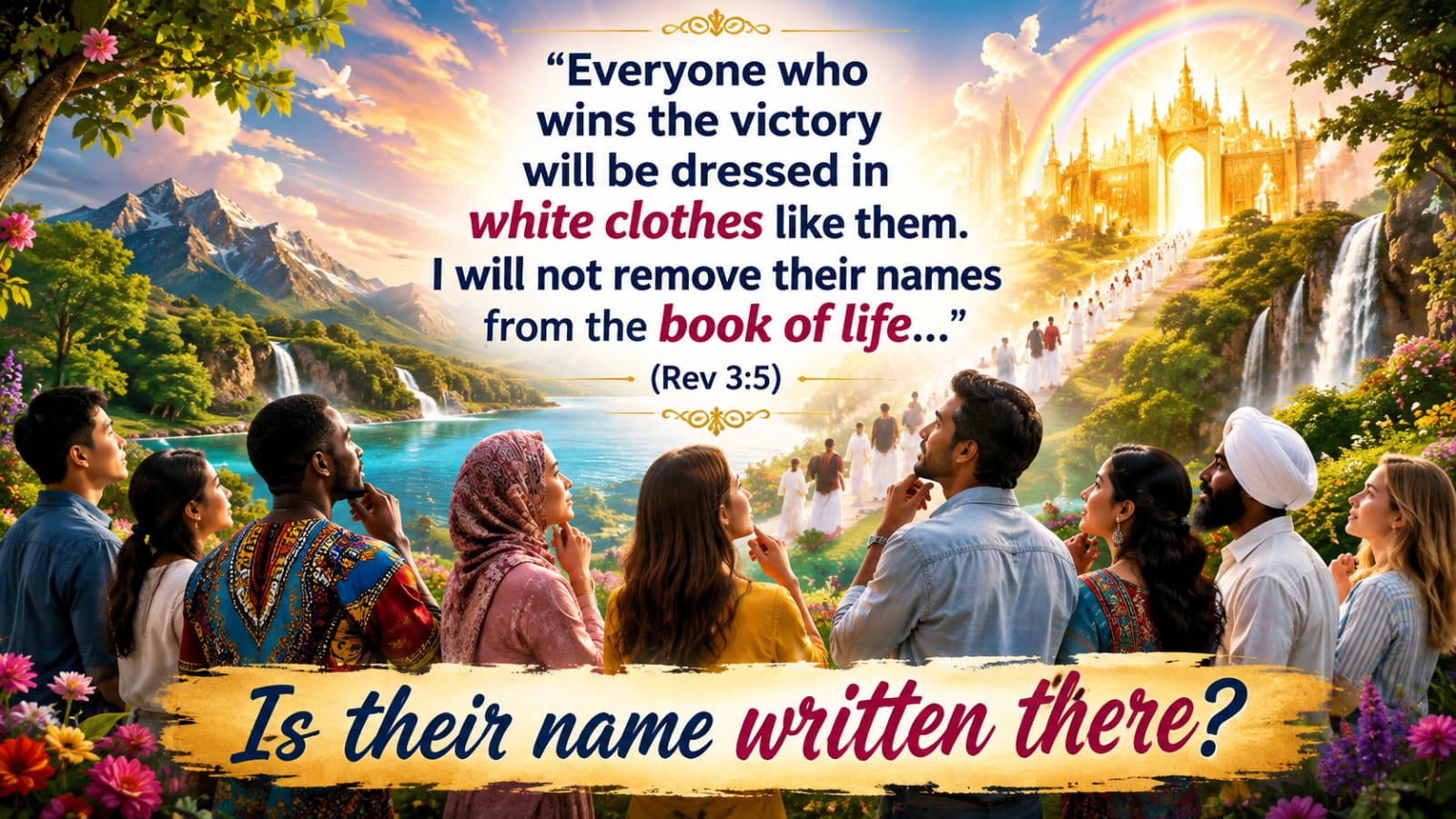
The one who overcomes…will be clothed in white clothing. And I will not blot out their name out of the Book of Life, but I will confess their name before My Father and before His angels. (Rev 3:5)
Rev 3:5
One of the most searching questions ever asked is found in an old gospel hymn called “Is My Name Written There?”
Lord, I care not for riches, neither silver nor gold;
I would make sure of Heaven; I would enter the fold.
In the book of Thy Kingdom, with its pages so fair,
Tell me, Jesus, my Saviour, is my name written there?
That question reaches beyond every earthly concern. Will I have enough money? Will I leave a legacy? Will people remember me? The Bible asks a far more important question: “Is my name written in Heaven?”
Jesus once said to the disciples:
“Notwithstanding in this rejoice not, that the spirits are subject unto you; but rather rejoice, because your names are written in heaven.” (Luke 10:20)
So here we see our Lord referring to some kind of book in Heaven where our names will be written. If Christ says that should be our greatest joy, then surely it deserves our deepest attention.
There Really Is a Book
The first clear reference to this book in heaven where names are written is found in one of Israel’s darkest moments. After the worship of the golden calf, Moses stood before God as an intercessor, and pleaded with God:
“Yet now, if thou wilt forgive their sin; and if not, blot me, I pray thee, out of thy book which thou hast written.” (Exodus 32:32)
Moses knew there was a book. He knew names were written there. He understood that being removed from that book meant eternal loss. Yet, his love for Israel was so great that he was willing, if possible, to bear their condemnation.
Now, we do know, of course, that Moses could not become their substitute. The Bible tells us that only Christ could do that.
“The LORD hath laid on him the iniquity of us all.” (Isaiah 53:6)”Christ also hath once suffered for sins, the just for the unjust, that he might bring us to God.” (1 Peter 3:18)
Moses pointed forward to the greater Mediator, Jesus Christ. But look at how God answered Moses’s prayer:
“Whosoever hath sinned against me, him will I blot out of my book.” (Exodus 32:33)
Scripture is clear on this. Each soul is accountable before God. No one enters heaven because of another person’s righteousness. No one is lost because of another person’s sin.
“The soul that sins, it shall die.” (Ezekiel 18:20)
What Should We Value Most?
The hymn that we are studying in this message begins with
Lord, I care not for riches, neither silver nor gold;
I would make sure of Heaven; I would enter the fold.
Those words remind us of Jesus’ question:
“For what is a man profited, if he shall gain the whole world, and lose his own soul?” (Matthew 16:26)
Everything we accumulate in this life will one day pass away. Jesus counsels all to
“Lay up for yourselves treasures in heaven.” (Matthew 6:20)
The greatest possession anyone can have is not wealth, influence, or even health. It is citizenship in God’s kingdom. Paul speaking of faithful fellow workers said
“…help those women who labored in the gospel with me and with Clement, and others of my fellow-laborers, whose names are in the Book of Life” (Philippians 4:3)
That is Heaven’s highest honor. To have our names written in “The Book of Life.”
A Book of Remembrance
Malachi gives us another glimpse into Heaven’s books.
“Then they that feared the LORD spake often one to another: and the LORD hearkened, and heard it, and a book of remembrance was written before him for them that feared the LORD, and that thought upon his name.” (Malachi 3:16)
God notices ordinary people. Jesus listens when His children speak together. Our Creator God remembers those who reverence Him. Hebrews says
“God is not unrighteous to forget your work and labour of love.” (Hebrews 6:10)
Nothing done for Christ is ever forgotten. Every quiet prayer. Every unseen sacrifice. Every act of kindness. Every faithful witness. All are remembered in Heaven. Not one effort for The Lord is ever in vain. (1 Cor 15:58)
Is There Hope for The Worst Sinners?
The second stanza of the hymn speaks for every honest believer
Lord, my sins they are many, like the sands of the sea
But Thy blood, O my Saviour, is sufficient for me.
How true that is. (Gal 6:14, Eph 2:13) The Bible never minimizes our guilt.
“The wage of sin is death.” (Romans 6:23) “All have sinned and come short of the glory of God.” (Romans 3:23)
Yet our sins are never greater than Christ’s grace. The hymn continues
For Thy promise is written in bright letters that glow
Though your sins be as scarlet, I will make them like snow.
Those words echo God’s personal invitation.
“Though your sins be as scarlet, they shall be as white as snow.” (Isaiah 1:18)
“The blood of Jesus Christ his Son cleanses us from all sin.” (1 John 1:7)
Not some sin. All sin. Paul, once a persecutor, could testify
“Christ Jesus came into the world to save sinners; of whom I am chief.” (1 Timothy 1:15)
If Christ could save Saul of Tarsus, who vigorously persecuted Christians, then surely He can save anyone who comes to Him with open, honest heart.
Can We Know Our Name Is Written There?
The refrain asks repeatedly
Is my name written there
On the page white and fair?
In the book of Thy Kingdom
Is my name written there?
“Is My Name Written There?” That is an important question that deserves a biblical answer. Many sincere Christians live with a tortuous uncertainty of their salvation. But Scripture was written so we might have assurance. “These things have I written unto you that believe on the name of the Son of God; that ye may know that ye have eternal life.” (1 John 5:13) Jesus promised “Anyone who cometh to me I will in no wise cast out.” (John 6:37)
We know because we believe His promise. We know because we prove His promises. In Great Controversy, page 632 we read
“we should now acquaint ourselves with God by proving His promises.”
“He that heareth my word, and believeth on him that sent me, hath everlasting life.” (John 5:24)
We know because His Spirit bears witness.
“The Spirit itself beareth witness with our spirit, that we are the children of God.” (Romans 8:16).
We know because His grace is producing new life within us. (2 Cor 5:17)
“We know that we have passed from death unto life, because we love the brethren.” (1 John 3:14)
We are not saved because we love. We love because we have been saved. Obedience is not the root of salvation. Obedience is not the price of salvation. Obedience is simply the fruit or the results of salvation. Jesus Makes an Extraordinary Promise. To the church in Sardis Christ says:
“They that overcome, I will not blot out their name out of the book of life, but I will confess his name before my Father, and before his angels.” (Revelation 3:5). Imagine that day. Your name spoken by Jesus Himself before the Father. What greater honor could ever be imagined?
Now, Jesus also said:
“Whosoever therefore shall confess me before men, them will I confess also before my Father which is in Heaven.” (Matthew 10:32). Today we confess Him before the world. Then Jesus will confess us before Heaven.
The Last Great Judgment
“And I saw the dead, small and great, stand before God… and another book was opened, which is the book of life.” (Revelation 20:12)
Then comes one of the most disturbing verses in that Scripture:
“And whosoever was not found written in the book of life was cast into the lake of fire.” (Revelation 20:15)
Nothing will matter more on that judgment day. Not earthly success. Not religious profession. Not human reputation. Only one question remains. Is my name written there?
Dear Jesus, is my name written there?
The hymn ends with confidence instead of uncertainty.
O that beautiful city with its mansions of light
With its glorified beings in pure garments of white;
Where no evil thing cometh to despoil what is fair;
Where the angels are watching, yes, my name’s written there.
John saw that same city
“And there shall in no wise enter into it any thing that defiles… but they which are written in the Lamb’s book of life.” (Revelation 21:27)
Notice the title. Not merely the Book of Life. It is called “The Lamb’s Book of Life.” Our names are there because of the Lamb who was slain. Because Jesus bore our sins. Because Jesus rose again. Because Jesus ever lives to intercede for us. (Heb 7:25) The final chorus changes from a question into a beautiful testimony. A powerful assurance.
Yes, my name’s written there
On the page white and fair
In the book of Thy Kingdom
Yes, my name’s written there.
That kind of confidence is not presumption. It is faith resting on the promises of God. The Bible opens Heaven just enough for us to glimpse a book. Moses knew about it. David alluded to it (Psalm 69:28). Jesus spoke of it. Paul rejoiced in it. John saw it opened in judgment. And one day soon every person who has ever lived will discover that this book is real. Do you want your name written in The lamb’s Book of Life? Do you want to see the names of your loved ones written there? Today Christ extends His invitation
“Come unto me.” (Matthew 11:28)
“Anyone who comes to me I will in no wise cast out.” (John 6:37)
If you have confessed your sins, trusted wholly in the blood of Jesus Christ, surrendered your life to Him, and continue abiding in Him by faith, (John 15:4,6,7) then your confidence rests not in your own goodness but in His unfailing promise. And on that glorious day, when the redeemed shall enter the Holy City and the Lamb welcomes His people home, may the question that once filled our hearts with longing become our everlasting assurance and testimony in song:
“Yes, my name’s written there
On the page white and fair
In the Book of Thy Kingdom,
Yes, my name’s written there.”
Amen. Amen! Come Lord Jesus!
Now, it is worth noting more closely how that the hymn intentionally moves from a fervent question to a rock-solid assurance. The first verse asks, “Is my name written there?” The final verse answers, “Yes, my name’s written there.”
This is just what the Bible shows too. Believers begin by seeking Christ (John 1:38–39. Then believers come to the full assurance through His promises (1 John 5:13), and ultimately they receive public confirmation when Christ confesses their names before the Father (Revelation 3:5). That movement from anxious inquiry to settled confidence in Christ is a powerful structure for the gospel today. One of the most powerful foundations of Scripture is that it tells one unified story.
From Question to Assurance Throughout the Bible
The Bible begins by introducing the idea that God keeps a record of those who belong to Him. God Has a Book. The first clear mention comes from Moses. “Yet now, if thou wilt forgive their sin; and if not, blot me, I pray thee, out of thy book which thou hast written.” (Exodus 32:32) God immediately confirms the reality of that book.
“Whosoever hath sinned against me, him will I blot out of my book.” (Exodus 32:33)
The Bible doesn’t explain the book because Moses already understands that it exists. David Recognizes the same Book. David later prays concerning those who persist in rebellion when he says: “Let them be blotted out of the book of the living and not be written with the righteous.” (Psalm 69:28). So now we learn another detail. The righteous are “written.” The wicked can be “blotted out.” So much for “once saved, always saved.” People can choose to turn their backs on God, and reject His mercy and guidance. Looking forward in prophetic time, Daniel is shown the closing events of earth’s history. “At that time thy people shall be delivered, every one that shall be found written in the book.” (Daniel 12:1). Now the book becomes associated with final deliverance. The question is no longer merely whether names are recorded.
Friends,Who will be found written there when probation closes?
Malachi Describes the People in the Book.
Then Malachi provides one of Scripture’s tenderest descriptions. “Then they that feared the LORD spake often one to another: and the LORD hearkened, and heard it, and a book of remembrance was written before him for them that feared the LORD, and that thought upon his name.” (Malachi 3:16)
Now we learn what characterizes these people. They fear God. They esteem His name. They encourage one another. God delights in remembering them. Notice that Malachi is not describing extraordinary people. He is describing faithful believers of all classes whose hearts belong to God. Then the Bible continues unfolding the picture. Jesus tells His disciples,
“Rejoice, because your names are written in heaven.” (Luke 10:20)
Later He promises “I will not blot out their name out of the book of life.” (Revelation 3:5)
John Sees the Great Judgment.
“Another book was opened, which is the book of life.” (Revelation 20:12) And then he describes the New Jerusalem.
“There shall in no wise enter into it any thing that defileth… but they which are written in the Lamb’s book of life.” (Revelation 21:27) The Bible moves quite naturally from recording, to remembering, to rejoicing, to rewarding.
Another progression that goes even deeper is found in Exodus where Moses asks: “Can my name be blotted out instead of theirs?” But as we previously discovered, a sinner cannot save another sinner.
Friends, We may be assured by God’s promises
“Though your sins be as scarlet, they shall be as white as snow.” (Isaiah 1:18)
Already the answer is beginning to appear. The problem is not merely having or not having our names in a book. The problem is our sins.
As we see in Isaiah 53, the Servant appears:
“The LORD hath laid on him the iniquity of us all.” (Isaiah 53:6) This is how we know that Someone truly can bear another’s guilt. Moses offered to do this. Jesus is The One who accomplished this. (John 3:16)
God Promises The New Covenant.
“I will forgive their iniquity, and I will remember their sin no more.” (Jeremiah 31:34)
Malachi speaks of a Book of Remembrance for God’s people. Jeremiah says God will remember our sins no more. He remembers His children while choosing not to remember the sins Christ has already borne. And finally, John brings both ideas together. The names are remembered. The sins are gone. Only those written in the Lamb’s Book of Life enter the Holy City.
One of the great themes of the Bible is that God knows:
God knows your name.
God knows your sins.
Christ bore your sins.
Therefore God remembers your name
but God does not remember your sins! That is the gospel.
Throughout the Bible, God repeatedly calls His people by name. “I have called thee by thy name; thou art mine” (Isaiah 43:1). Jesus says of the Good Shepherd, “He calleth his own sheep by name” (John 10:3). At the resurrection, Mary recognizes Jesus when He simply says, “Mary” (John 20:16).
The climax of the hymn here is not merely that our names are written in His book, but that our names are known by His heart. The Lamb’s Book of Life is not an impersonal registry; it is the record of those whom the Shepherd knows, loves, and has redeemed. (John 17:3). That makes the question, “Is my name written there?” profoundly personal rather than merely a strictly juristic question.
Is My Name Written There?
The hymn asks a deeply personal question: “Is my name written there?” Yet the gospel invites us to look beyond ourselves and consider those around us. As we think of our spouses, children, parents, neighbors, friends, and co-workers, another solemn question arises: Are their names written there? The thought should not lead us to judgment, but to compassion, prayer, and faithful witness. In the great controversy between Christ and Satan, every soul is precious to God, and He desires that none should perish. (John 3:15,16,2 Pet 3:9)
The names recorded in Heaven are attached to real people we interact with every day. People who may be struggling, searching, or unaware of God’s love. When we go one step further and we ask whether their names are written there, we are reminded of our privilege and responsibility to reflect Christ’s character, share His truth, and pray earnestly that those we love will one day stand with us before God’s throne, rejoicing that their names too, are written in the Lamb’s Book of Life. (Acts 11:14, Acts 16:31)